What you will learn
- Understand the shift from traditional software architecture to the Agentic Stack.
- Identify the five core layers of a raia AI Agent.
- Trace the exact lifecycle of a user request through the system.
- Understand how context retrieval (RAG) drives dynamic reasoning.
The Paradigm Shift: From Frameworks to Platforms
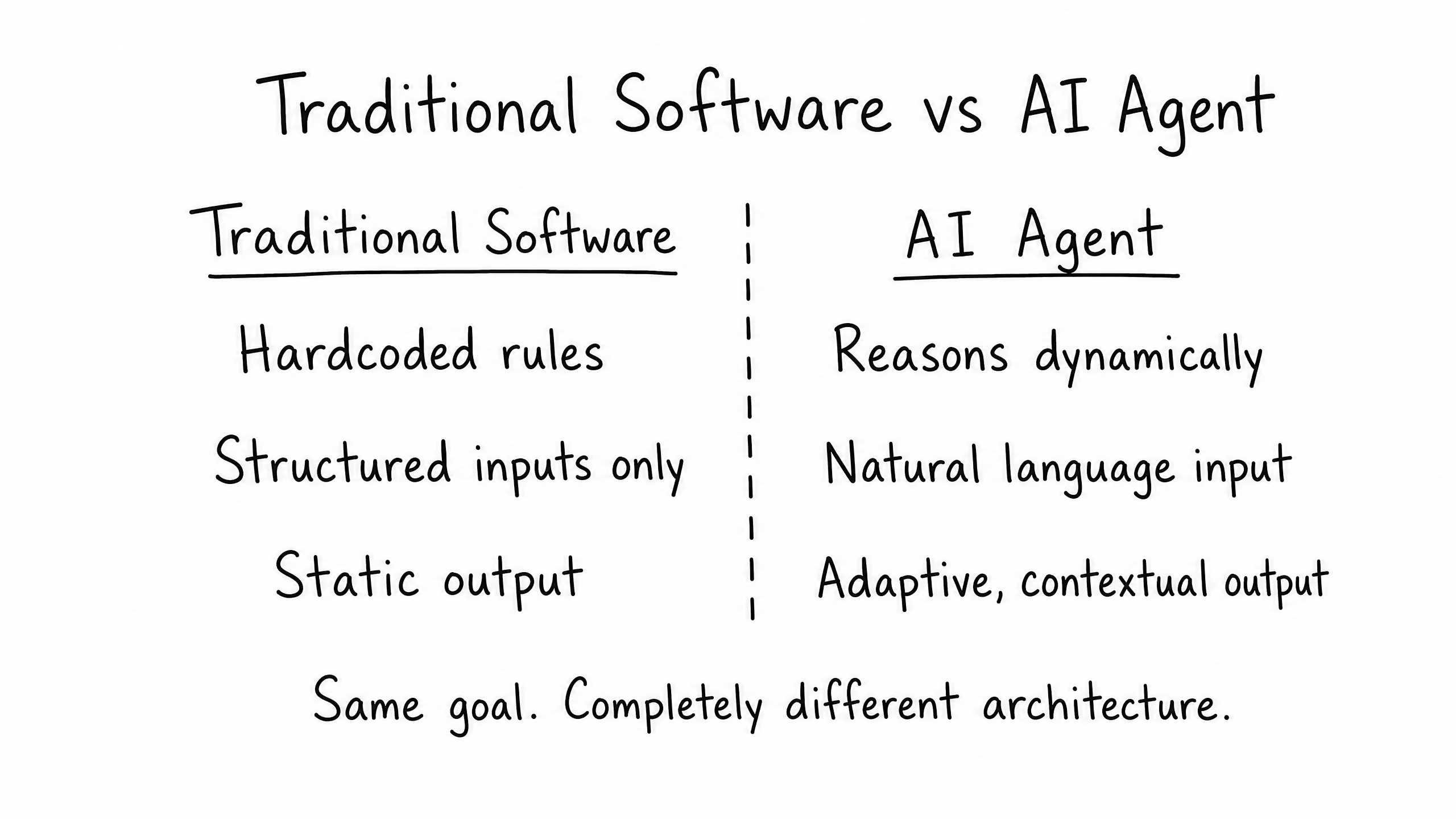
In traditional software development, you write hardcoded logic to handle structured inputs and produce static outputs. If you want an application to do something new, you write a new function.
An AI Agent operates on a completely different architecture. It is an autonomous system that blends reasoning, memory, integration, and communication. It does not follow a hardcoded script; instead, it uses a Large Language Model (LLM) to reason dynamically over retrieved context and determine the best path forward.
raia is a platform, not just a DIY framework. While frameworks require you to stitch together models, vector databases, and orchestration tools from scratch, raia provides the complete "Agentic Stack" out of the box, allowing you to focus on behavior and integration rather than infrastructure.
The Agentic Stack
The architecture of a raia agent consists of five modular layers. Each layer contributes context, logic, or data to the final output.
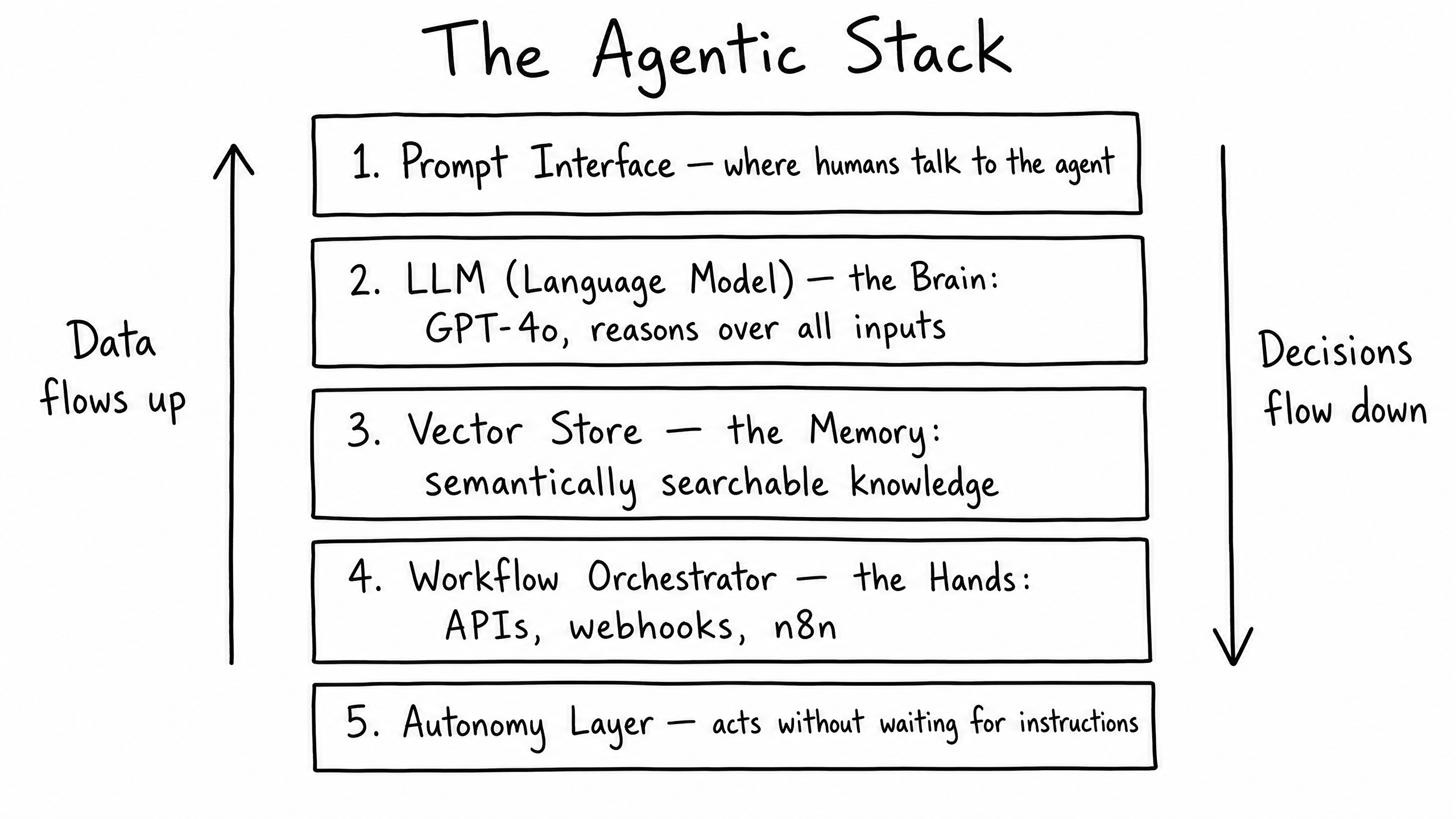
Layer 01
Prompt Interface
The new 'UI.' Instead of buttons or forms, users interact via natural language — Live Chat, SMS, Email, Voice, or an API call.
Layer 02
LLM (The Brain)
The reasoning engine (e.g., GPT-4o) that understands user intent, processes retrieved context, and formulates the response or action.
Layer 03
Vector Store (The Memory)
Where the agent's knowledge lives. Documents uploaded to raia Command are converted to Markdown, chunked, and embedded into a semantically searchable database.
Layer 04
Workflow Orchestrator (The Hands)
The action layer. Through Webhooks, Functions, or n8n integrations, the agent can push data to a CRM, trigger an email, or query an external API.
Layer 05
Autonomy Layer
For advanced use cases, agents can initiate actions without waiting for a user prompt — operating asynchronously based on scheduled triggers or system events.
The Request Lifecycle
What actually happens under the hood when a user sends a message to an agent? It is a highly coordinated, six-step process.
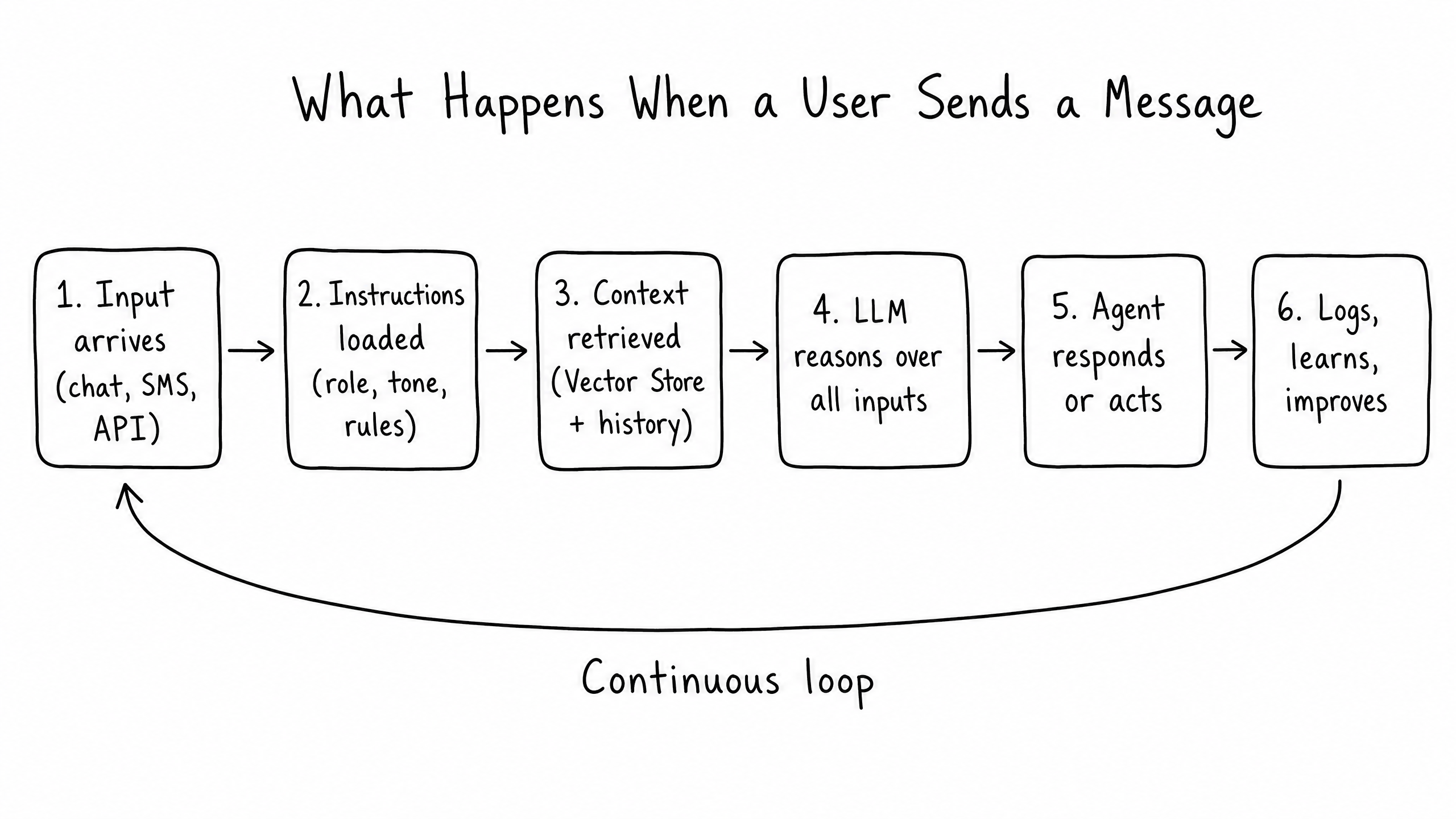
- 1
Input Arrives
The agent receives a natural language message (e.g., via raia Chat) or a structured API request.
- 2
Instructions Loaded
The system loads the agent's core directives — its role, tone, formatting rules, and behavioral boundaries.
- 3
Context Retrieved
The system queries the Vector Store for relevant knowledge chunks and retrieves the recent conversation history. This is the Retrieval-Augmented Generation (RAG) phase.
- 4
LLM Reasons
The LLM receives the user input, the instructions, and the retrieved context. It reasons over all these inputs simultaneously to determine the best response.
- 5
Agent Responds or Acts
The agent formulates a reply, asks a clarifying question, or triggers a function/webhook to take an action in an external system.
- 6
Log and Learn
The interaction is logged in raia Copilot, where human operators can review, rate, and provide feedback to improve future performance.
Frequently Asked Questions
Do I need to manage the vector database infrastructure?
No. raia Command handles document conversion (to Markdown), chunking, embedding, and vector storage automatically. You just upload the files.
Can I swap out the underlying LLM?
raia abstracts the model layer to provide a consistent experience, optimizing prompts and retrieval for the current state-of-the-art models (like GPT-4o). You focus on the instructions and data.
How fast is the retrieval process?
Semantic search across the vector store happens in milliseconds. Newly uploaded documents are embedded and become searchable within approximately one minute.