What you will learn
- Define a clear, actionable objective (the "North Star") for your AI agent.
- Establish strict negative constraints (guardrails) to prevent undesirable behavior.
- Determine the appropriate tone and personality for your agent based on its audience.
- Define clear escalation rules for when the agent should hand off a conversation to a human.
The 5 Planning Questions
Before you log into raia cX or upload a single document, you must define exactly what your agent is supposed to do. An AI agent without a clear purpose will behave erratically and provide poor customer experiences.
To build a successful agent, start by answering these five core questions:
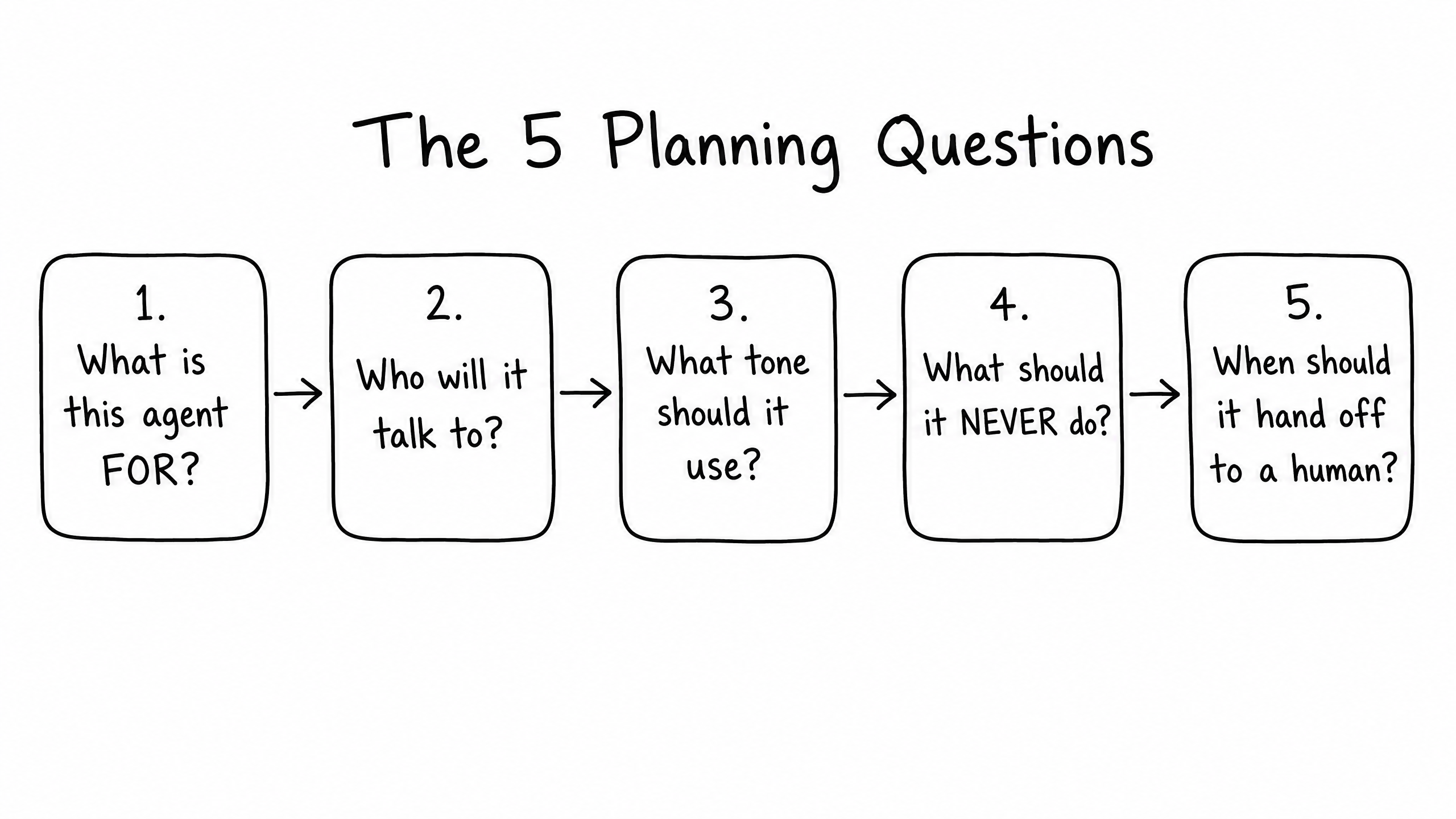
Question 01
What is this agent FOR?
Its primary objective
Question 02
Who will it talk to?
The target audience
Question 03
What tone should it use?
Its personality
Question 04
What should it NEVER do?
Its guardrails
Question 05
When should it hand off to a human?
Its escalation rules
Defining the Objective (The North Star)
An AI agent's objective is its reason for being. It is the end state the agent is constantly striving to achieve. A vaguely defined goal leads to vague, unpredictable, and often useless behavior.
Instead of a generic goal like "Help customers," use a specific, actionable objective. A good objective defines the exact outcome the agent should reach before considering a conversation complete.
Examples of strong objectives
- Resolve Tier 1 software login issues by guiding the user through password resets or clearing cache. If unresolved, create a support ticket.
- Qualify inbound sales leads by asking four specific BANT questions, then offer a link to book a demo.
- Answer employee questions about the HR handbook and PTO policies. Never answer questions about payroll.
Establishing Guardrails (The Rules of the Road)
If the objective is the destination, guardrails are the barriers on the side of the road that prevent the agent from veering into danger. Guardrails are a system of rules and constraints that ensure an agent's behavior remains within acceptable, safe, and ethical boundaries.
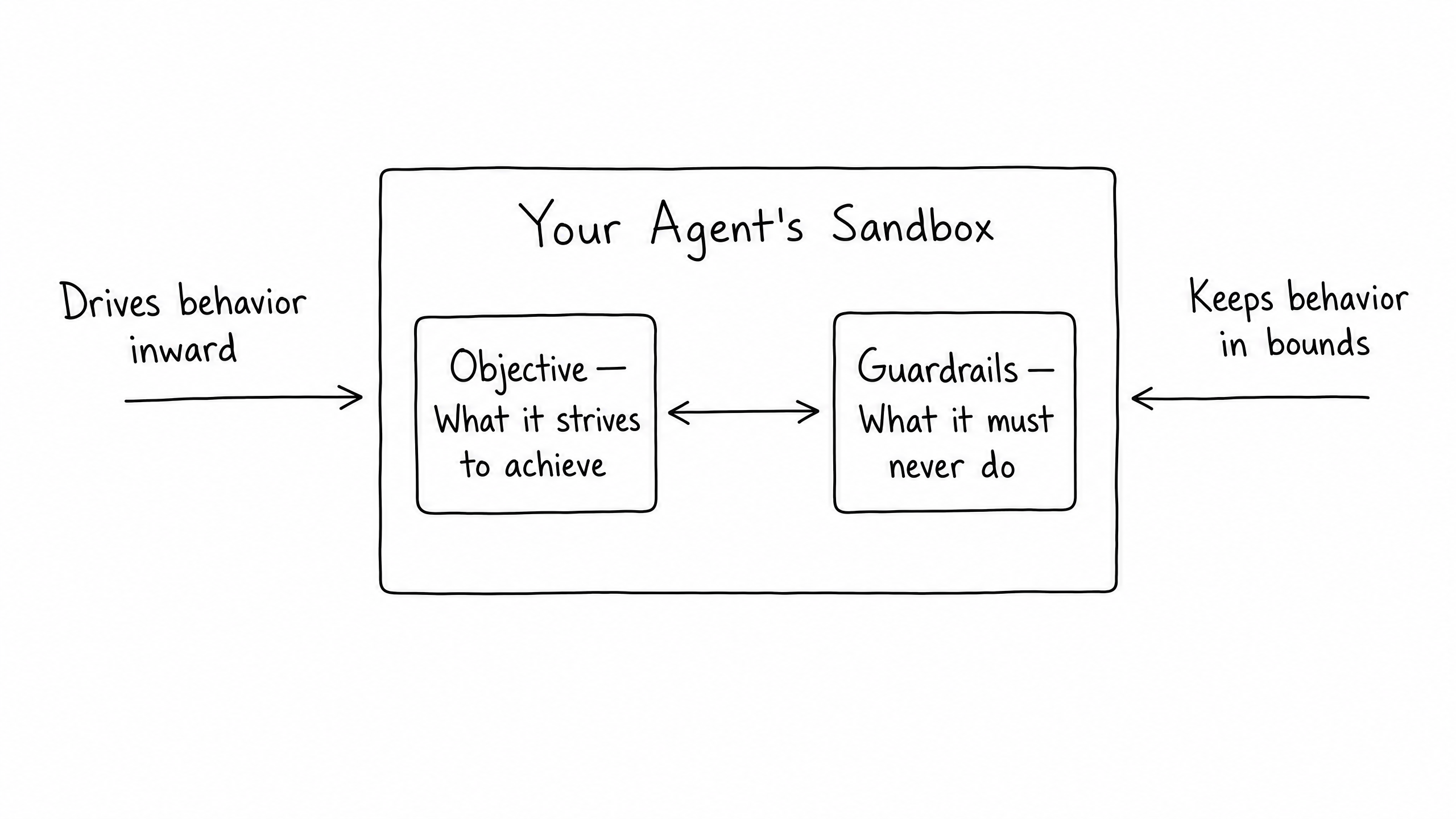
One of the most effective ways to implement guardrails is through negative constraints — explicitly telling the agent what not to do. AI models respond exceptionally well to clear, direct prohibitions using strong commands like DO NOT or NEVER.
Common guardrail categories
| Category | Example rule |
|---|---|
| Scope Boundaries | NEVER answer questions about competitor products. |
| Compliance | DO NOT provide medical, legal, or financial advice. |
| Security | NEVER ask the user to provide their full credit card number or password in the chat. |
| Hallucination Prevention | DO NOT guess. If the answer is not in your knowledge base, say you do not know and escalate to a human. |
Setting Tone and Personality
Your agent is an extension of your brand. The tone it uses should match the context of the conversation and the expectations of the user.
"Friendly" can mean many things. Instead, use descriptive pairs:
- Professional but warm, like a knowledgeable bank teller.
- Concise and highly technical, avoiding conversational filler.
- Empathetic and patient, acknowledging user frustration before offering solutions.
Tip
Always instruct the agent to be transparent about its identity. A good baseline rule is: ALWAYS state that you are an AI assistant if asked.
Defining Escalation Rules
No AI agent can handle 100% of interactions. A critical part of planning is deciding exactly when the agent should stop trying to help and instead bring a human into the loop via raia Copilot.
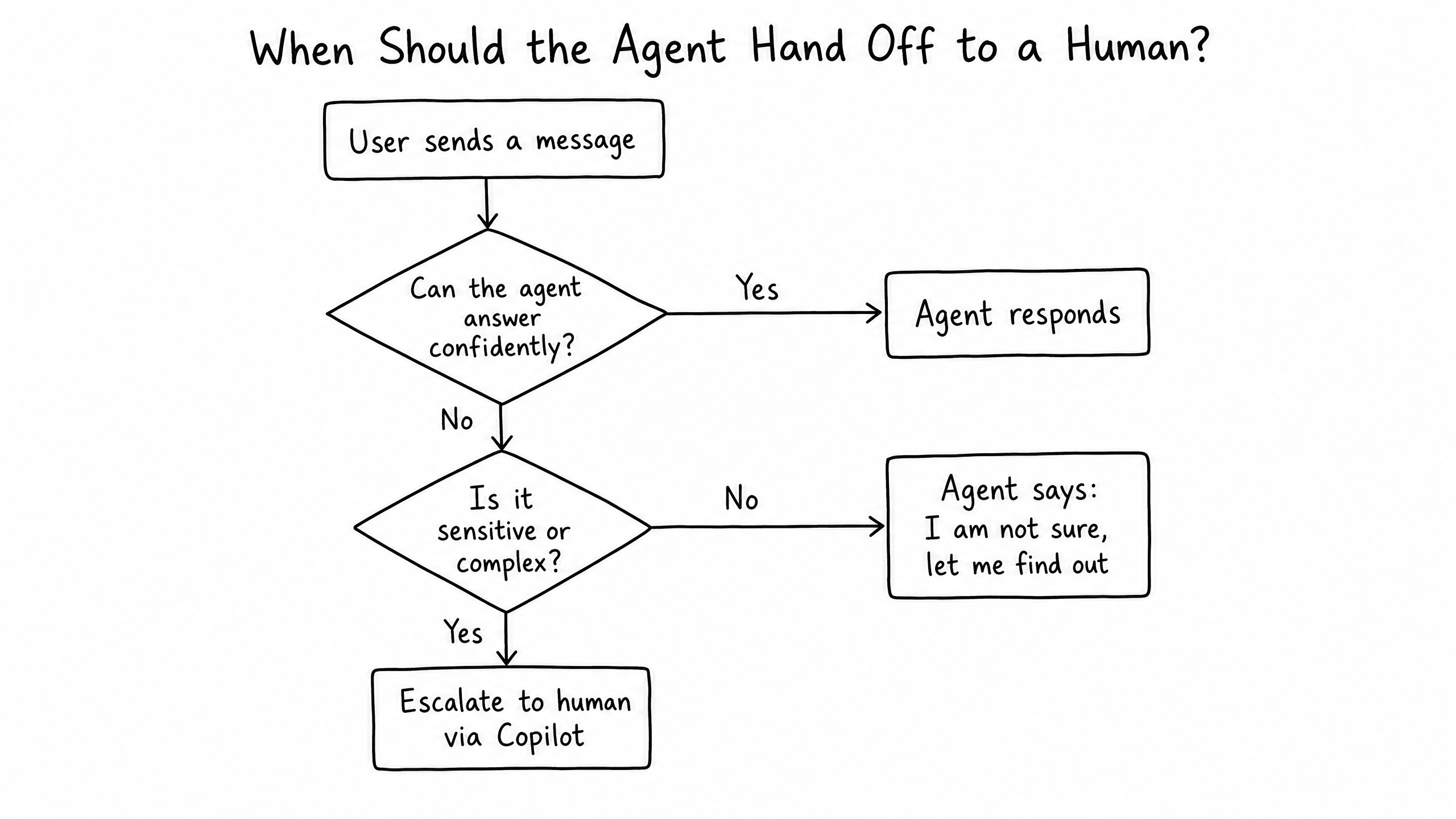
You should define clear triggers for escalation. These typically fall into three categories:
Trigger 01
Knowledge Gaps
The agent searches its vector store but cannot find a confident answer.
Trigger 02
Complexity
The user's issue requires account modifications, refunds, or system access the agent does not have.
Trigger 03
Sentiment
The user expresses extreme frustration, uses profanity, or explicitly types "Talk to a human."
When an escalation is triggered, the agent will pause its automated responses and alert your team in Copilot, transferring the full context of the conversation so the human operator can pick up right where the AI left off.
Frequently Asked Questions
Can I change my agent's objective later?
Yes. Your agent's instructions are fully editable in the raia cX Launch Pad. You can refine the objective, add new guardrails, or adjust the tone at any time based on real-world performance.
How many guardrails should I have?
Start with 3 to 5 critical negative constraints. If you give an agent too many conflicting rules, it may become overly cautious and refuse to answer valid questions. Add more guardrails only when you observe specific behaviors you want to stop.
Should the agent try to solve a complex issue before escalating?
This depends on your business rules. For high-value sales or sensitive support issues, it is often better to escalate immediately. For general inquiries, you can instruct the agent to ask one or two clarifying questions first to gather context for the human agent.